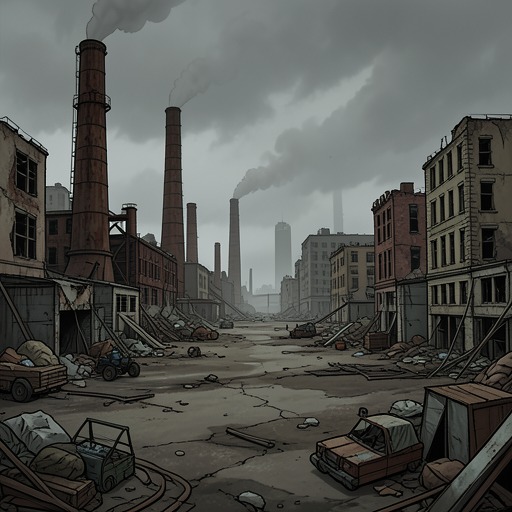
Cal Industrial District
Blood ShotThe Cal Industrial District is presented as a working industrial area and a place of wetlands, joined in the investigation by the route that leads V. I. Warshawski from the city toward the site where Nancy Cleghorn’s body is found. Its significance lies in that uneasy proximity: the district is both a lived-in South Side community and the landscape of a killing that turns local environmental and political conflicts into a personal investigation.
Setting and Approach
When Warshawski explains the geography to a visitor, she uses a city map to trace the journey from Houston Street, where she grew up, down to the Cal Industrial District and its wetlands. The map makes the district legible as part of a remembered South Side rather than an isolated point on the city’s edge. Her companion, who has never been below the Field Museum, has no prior sense of life there; the contrast exposes how unfamiliar the area remains to someone whose experience of Chicago has not extended that far south.
The approach is also a return. Warshawski’s childhood connection to Houston Street gives the route a personal starting point, while the industrial district and wetlands mark a more troubled present. In the conversation, the name Dead Stick Pond prompts her companion to recognize the harshness of the place before he fully understands its geography.
The Wetlands and Nancy Cleghorn’s Death
The district’s wetlands enter the narrative through Nancy Cleghorn’s murder. Warshawski tells her visitor that Nancy was found in the wetlands after she herself had made the trek to Dead Stick Pond. The account binds a specific landscape to the loss of a friend with whom Warshawski had played basketball: the place is not merely a setting for the investigation, but the destination of a journey undertaken in the aftermath of violence.
Warshawski’s companion responds by warning that the suspected force behind the events may be much larger than she is. His comparison to facing a tank division alone gives the district’s geography a second dimension: reaching the wetlands has brought the investigator into a conflict whose scale may exceed the local scene where its consequences became visible.
Industry, Politics, and Community Disputes
The district’s wider context includes a proposed SCRAP recycling center and opposition to giving the proposal a hearing. Nancy reports that the zoning-board chairman, O’Gara, said a proposal should not proceed without community backing, then claimed he had heard from people who opposed it. Caroline argues that the political connection runs through Art Jurshak’s ties to the old ward Democrats. The exchange shows how decisions about a local environmental project are filtered through claims of community support and established political relationships.
A separate clue in Nancy’s files links Art Jurshak & Parma to the insurance business around Humboldt Chemical’s Xerxes plant. The document, dated 1963, says the firm had become fiduciaries for the plant and includes an actuarial study comparing its losses with those of similar companies in the area. Warshawski initially cannot see why Nancy kept the apparently routine paperwork, but its age and its connection to the plant make it a lead in the investigation. The evidence establishes a connection among political influence, insurance, and industrial business; it does not by itself explain the document’s significance to Nancy’s death.
A District Connected to the City
Warshawski’s inquiries extend beyond the wetlands into the political and financial institutions connected to the South Side. In East Side, she visits the ward offices in a brick two-flat on Avenue M. The building’s large sign identifies Art Jurshak as alderman and Freddy Parma as ward committeeman, while the adjoining storefront still houses the insurance agency that helped give Art a foothold in the community. The scene offers a concrete picture of political and commercial interests sharing a neighborhood address, even as the investigation follows their connections across the city.
At Ironworkers Savings & Loan, Warshawski learns that Gustav Humboldt has remained on the board since joining in the 1940s, despite the later growth of his company and his other corporate directorships. That discovery sharpens her suspicion that a problem involving insurance for the Xerxes workforce is being kept from view. The Cal Industrial District thus sits within a larger network of industrial, financial, and political relationships: the wetlands are where the investigation’s human cost becomes immediate, while the surrounding civic geography helps Warshawski pursue the interests that may lie behind it.